SATURN'S HEXAGON
A SIX-SIDED STORM 30,000 KM ACROSS

The full story
- 1980 – 1981
NASA's Voyager 1 and Voyager 2 each fly past Saturn and photograph its north pole. The frames are archived; the shape in them goes unnoticed.
- 1988
Astronomer David Godfrey reprocesses the Voyager 2 images into a polar projection and maps them — revealing a near-perfect six-sided pattern circling the pole.
- Early 1990s
The hexagon disappears from view through Saturn's long polar winter, and isn't confirmed again until the Hubble Space Telescope observes the pole.
- 2004 – 2017
The Cassini orbiter captures the hexagon in full high-resolution detail across visible, infrared and multi-filter imaging — confirming a real, remarkably stable atmospheric jet-stream and vortex structure roughly 30,000 km across. Not an imaging artifact, and not seen anywhere else in the solar system.
- Today
Scientists still do not fully understand what maintains its precise six-sided shape.
The images — Voyager to Cassini
All imagery below is public domain, sourced from NASA's own archive.
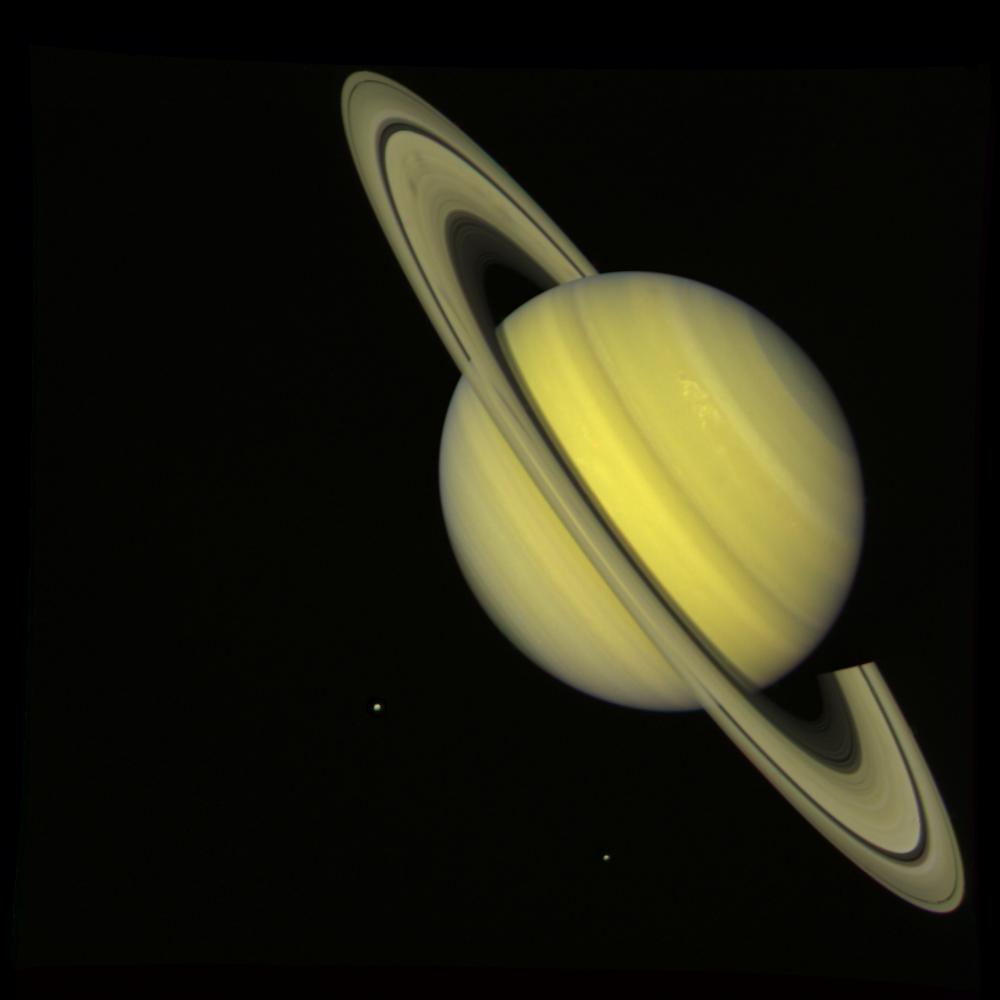
Voyager 2's view of Saturn during its August 1981 flyby. The spacecraft's polar frames carried the hexagon years before anyone recognised it.
Image: NASA/JPL-Caltech · PIA00030
View on NASA archive ↗
Cassini's thermal-infrared confirmation of the hexagon, seen straight through the darkness of Saturn's polar winter.
Image: NASA/JPL-Caltech/University of Arizona · PIA09186
View on NASA archive ↗
An infrared mosaic that showed the complete six-sided shape clearly for the first time, corner to corner.
Image: NASA/JPL-Caltech/University of Arizona · PIA10583
View on NASA archive ↗
Sunlight returning to the northern hemisphere lit the hexagon in visible light after decades of polar night.
Image: NASA/JPL/Space Science Institute · PIA11682
View on NASA archive ↗The highest-resolution colour view of the hexagon, assembled from images taken over ten hours of Saturn's rotation.
Image: NASA/JPL-Caltech/Space Science Institute · PIA17652
View on NASA archive ↗
The same structure through four different filters — the hexagon holds its shape at every wavelength.
Image: NASA/JPL-Caltech/Space Science Institute · PIA21053
View on NASA archive ↗
One of Cassini's last close near-infrared views before the spacecraft's final plunge into Saturn.
Image: NASA/JPL-Caltech/Space Science Institute · PIA21327
View on NASA archive ↗Creator's perspective — interpretation, not established science
Everything above is documented astronomy. What follows is my own reading of it.
Finding the hexagon was part of what set the Moon Master's seven-dimensional planetary framework in motion. A planet is usually drawn as a sphere — a single, smooth idea. Saturn refused that. It held a six-sided form at its pole for decades, through winter and summer, stable enough to be photographed by four different spacecraft across nearly forty years.
That suggested to me that planetary bodies may express structure beyond the sphere — that each one might carry a geometry of its own. The Moon Master gives each of the seven classical planets a distinct geometric solid for exactly that reason, with Saturn's hexagonal prism the one form the archive already photographed for us.
This is a creative thread, not a scientific claim. The science stops at the section above; this part is the watch's own story.
⚙ Back to the watch